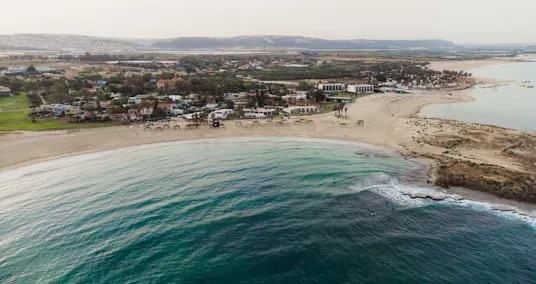
The discovery was made in an ancient shipwreck in the Dor Lagoon near the Carmel Coast, where archaeologists recovered nine pieces of unprocessed iron known as “blooms.”
Researchers from the University of Haifa said Wednesday that an underwater excavation off Israel’s northern Mediterranean coast uncovered what they described as the earliest known cargo of raw iron transported by ship, dating back around 2,600 years, Xinhua reported.
The discovery was made in an ancient shipwreck in the Dor Lagoon near the Carmel Coast, where archaeologists recovered nine pieces of unprocessed iron known as “blooms.” According to the university, the find provides direct evidence of how iron was transported in its earliest commercial stages.
The material was preserved in its original form, having solidified directly in a smelting furnace without undergoing forging or further refinement. Researchers said this distinguishes the cargo from later iron artifacts that typically show signs of shaping or tool-making.
Unlike copper and bronze, which could be melted into liquid form in ancient production processes, iron was heated with charcoal to produce a solid, porous mass. That mass was generally hammered to remove impurities and create denser material suitable for tools and implements.
The recovered blooms showed no indication of that secondary processing stage, suggesting they were transported immediately after production.

Earliest iron shipment discovered in ancient Mediterranean wreck
To determine the age and condition of the cargo, researchers conducted microscopic and chemical analyses.
Radiocarbon dating was also carried out on charred wood embedded in one of the pieces, helping confirm the timeline of the shipment. The findings were published in the journal Heritage Science.
Researchers said the cargo indicates that iron was being moved in raw form from production sites to other locations for further processing, pointing to a level of specialization in ancient manufacturing and trade networks in the Mediterranean.
The University of Haifa said the discovery provides new insight into early iron production and distribution practices in the region.
LATEST POSTS
- 1
 This Is Canada's Only Province Without Any Bears
 - 2Israeli archaeologists launch project to trace origins of ancient pottery
- 3There was a bit of toilet trouble on NASA's Artemis 2 mission to the moon
- 4Good ways to respond if your kid brings home less-than-ideal grades
- 5Mummified cheetahs found in Saudi caves shed light on lost populations




- December's overlooked meteor shower peaks next week — will the Ursids surprise us?
- Artemis 2 moon rocket gets 'America 250' paint job | Space photo of the day for Dec. 23, 2025
- Canada cancels its 1st moon rover: 'It's hopefully not a lost cause'
- Emergent Cold LatAm opens state-of-the-art cold storage hub in Guadalajara
- Minnesota jury says Johnson & Johnson owes $65.5 million to woman with cancer who used talcum powder
- Agricultural drones are taking off globally, saving farmers time and money
- ByHeart baby formula from all lots may be contaminated with botulism bacteria, tests show
- Vote In favor of Your Favored Language Interpretation Administration
- Interstellar comet 3I/ATLAS isn't an alien spacecraft, astronomers confirm. 'In the end, there were no surprises.'